
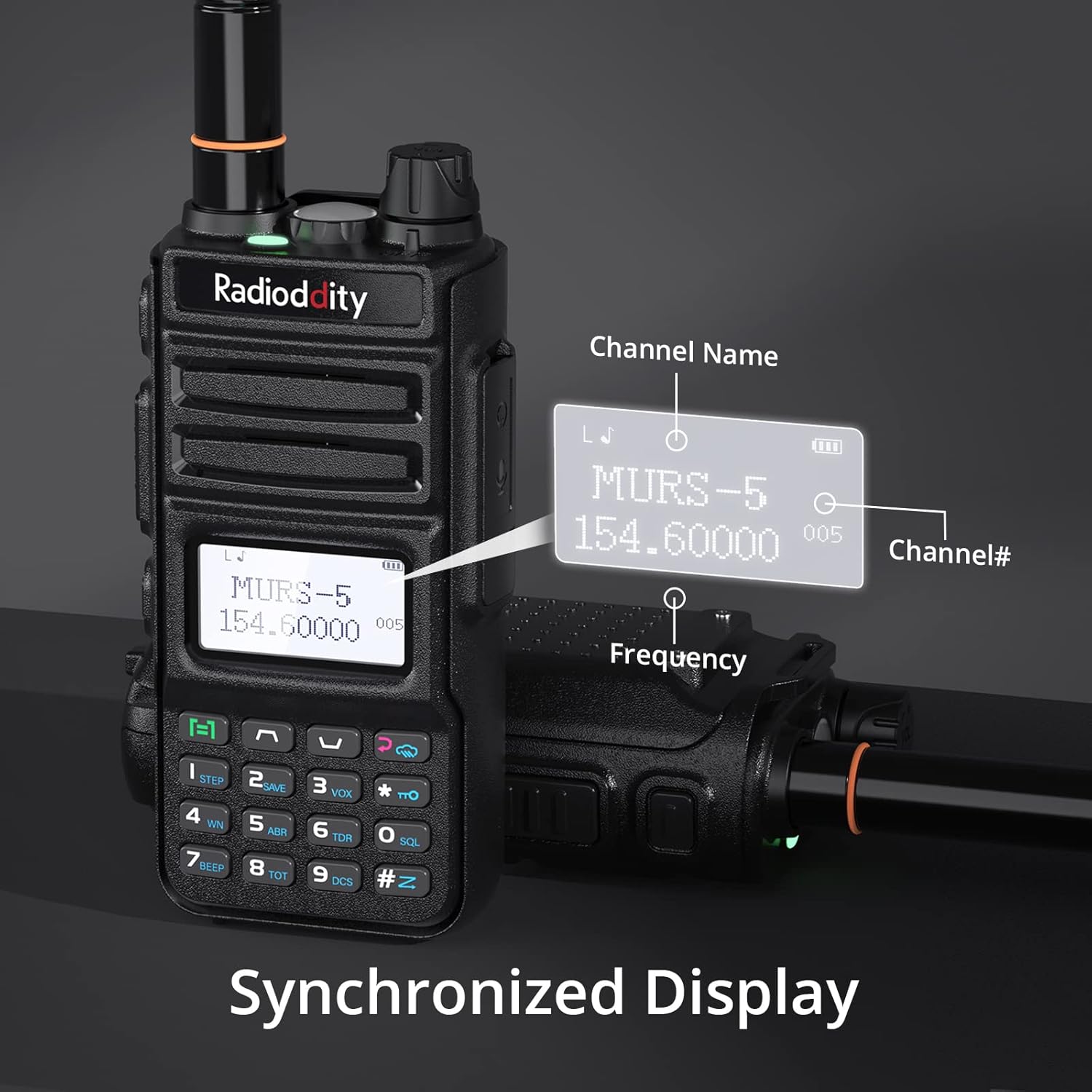
MURS Radio is a license-free emergency communications tool hiding in the VHF spectrum that outperforms GMRS and FRS where it matters most: in forests, hills, and rural terrain. Known as the Multi-Use Radio Service, this forgotten VHF service deserves a spot in every emergency kit.
Long-range communication can be critical during a grid-down emergency, and a MURS radio excels where GMRS, FRS, and Ham UHF radios don’t. No license, no fees, no FCC paperwork. Just reliable VHF communication.
What Is MURS Radio?
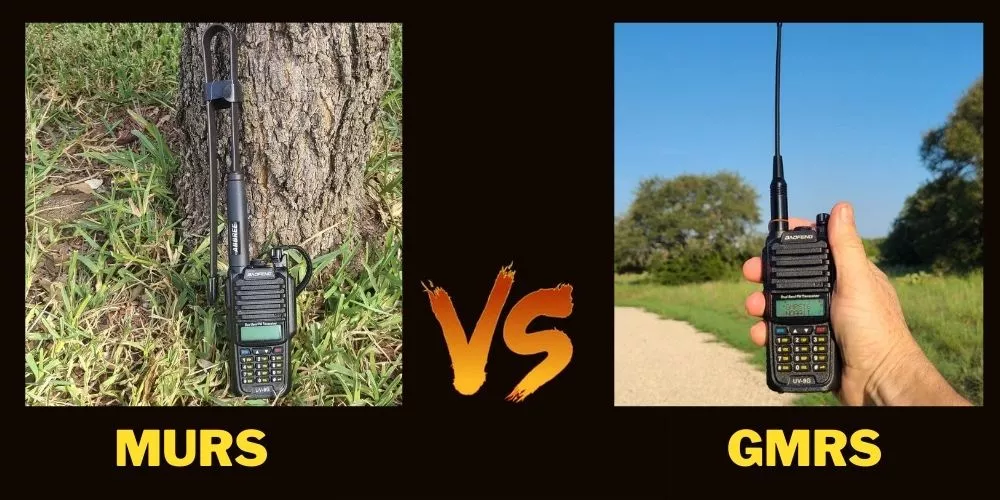
This service is a licensed-by-rule personal radio service authorized by the FCC under Part 95 Subpart J. It operates on five designated VHF frequencies between 151 and 154 MHz with a maximum transmitter power of 2 watts. Therefore, no individual license is required to operate it.
Any person in the United States can use MURS legally for personal or business communications without ever contacting the FCC.
The 5 FCC-Authorized MURS Frequencies Are:
- 151.820 MHz – 11.25 kHz narrowband – Channel 1
- 151.880 MHz – 11.25 kHz narrowband – Channel 2
- 151.940 MHz – 11.25 kHz narrowband – Channel 3
- 154.570 MHz – 20 kHz wideband – Channel 4 [Blue Dot]
- 154.600 MHz – 20 kHz wideband – Channel 5 [Green Dot]
Channels 4 and 5 also allow data and wireless remote monitoring, including ranch gate openers, driveway alarms, and motion-triggered alert systems.
GMRS vs MURS Radio: Why Everyone Chose GMRS
Walk into any Walmart or Amazon and search for two-way radios. You will find dozens of FRS/GMRS bubble-pack radios promising 30-mile range. GMRS became the de facto standard because it was bundled with FRS and had massive retail presence.
GMRS operates on UHF frequencies around 462 and 467 MHz. It has repeater capability and up to 50 watts of power. However, there is a critical problem for emergency preparedness: GMRS requires an FCC license.
As of 2023, a GMRS license costs $35 and covers your immediate family for ten years. That’s not expensive, but it introduces friction. In a genuine emergency, anyone in your group who is not licensed or on your license is technically operating outside FCC rules.
With MURS, you can legally hand a radio to any neighbor, church group member, or mutual aid partner with zero preparation. No registration. No application. No waiting period. No fee. Full stop. This frictionless access makes it invaluable for community emergency communications. If you are building a full emergency communications plan, this is the easiest place to start.
Why MURS Radio Beats GMRS: The VHF vs UHF Physics Advantage
Radio propagation is governed by physics, and this is where the case for VHF becomes compelling.
1. It Punches Through Foliage
This is the single most important factor outside a dense urban core. VHF signals at 151 MHz experience dramatically less attenuation through vegetation than UHF signals at 462 MHz. Trees, brush, and crops absorb UHF energy. A 2-watt VHF radio talking through a forest will consistently outperform a 2-watt GMRS radio by a substantial margin. For rural homesteaders, farmers, and hikers, this is a fundamental advantage.
2. It Follows Terrain Better
UHF signals are strictly line-of-sight. They struggle with rolling hills and valley floors. In contrast, VHF signals experience more diffraction around terrain obstacles. They don’t pass through mountains, but they handle the gentle, irregular topography of most of America with more grace than GMRS.
3. The Ground Wave Advantage
At VHF frequencies, ground wave propagation is more meaningful. The signals hug the surface of the earth, extending useful range in flat farmland, prairie, and coastal geography far beyond what power alone would suggest.
4. Quieter Noise Floor
The UHF spectrum around GMRS is crowded and noisy. The MURS frequencies sit in a lightly-used portion of the VHF band with a quieter noise floor, which means better intelligibility at marginal signal levels – exactly when it matters in an emergency.
License-Free MURS Radio: No Barriers to Community Preparedness
Emergency preparedness is a community endeavor. The most resilient neighborhoods are not those with the best individual gear – they are the ones with the strongest communication networks.
GMRS erects a barrier. That $35 fee is trivial to hobbyists, but it is a real barrier for an elderly neighbor on a fixed income or a teenager who wants to help. When you hand someone a GMRS radio, you may be handing them a device they cannot legally transmit on.
This service removes that barrier completely. You can pre-program a channel and CTCSS tone, drop it in a bag, and give it to your neighbor with one instruction: “press this button to talk.” For more on license-free options, see my guide to best emergency radios that require no license.
Best MURS Radio Hardware for 2026: How to Solve the Market Gap
The honest counterargument is hardware availability. You will not find these radios in a Walmart endcap. The purpose-built market is thin, but solvable.
Top FCC-Certified MURS Radio Options:
- Wouxun KG-805M – The most popular dedicated MURS radio
- Dakota Alert Base Stations & Handhelds – Built for farm use with sensor integration
- Ritron & Kenwood ProTalk Models – Professional-grade hardware
- Budget Option: Any programmable VHF radio programmed for MURS frequencies via CHIRP software
Where a MURS Radio Fits in Your Emergency Communications Plan
MURS Excels At:
- Rural and semi-rural emergency communications where foliage and terrain favor VHF
- Farm and ranch coordination across fields and wooded lots
- Community-wide distribution to neighbors who will not get a GMRS license
- Off-grid homestead communication between structures and patrol routes
- Perimeter monitoring via sensor systems
Less Ideal For:
- Dense urban environments where GMRS repeater infrastructure helps
- Communication with the broader GMRS or ham radio communities
- Scenarios requiring 5- to 50-watt GMRS mobile and base stations
MURS Radio vs Ham Radio: The Unlicensed Shadow of 2-Meter
Amateur radio operators have long understood VHF advantages. The 2-meter ham band at 144–148 MHz sits right next to these frequencies and shares its propagation characteristics. Ham operators have built extensive VHF repeater networks.
The difference: ham radio requires a license. This option captures the core VHF propagation advantage and delivers it with nothing required from the user except possession of a compliant radio.
If you want to pursue ham radio as your next step, see my foolproof guide on how to get your Technician Ham Radio License for FREE.
Final Verdict: Why Your Emergency Kit Needs a MURS Radio Today
If you are already a GMRS licensee, this does not replace what you have. It supplements it and extends your network to people outside your licensed household.
If you are building a plan from scratch and most users will never get a license, MURS is your primary tool.
If you live in a rural area, operate a farm, or spend time in wooded or rolling terrain, a MURS radio will consistently outperform FRS/GMRS handhelds at low power.
The radio service the preparedness community overlooked has been sitting quietly in the VHF band since 2000, asking nothing of you. It is time more people paid attention.
FCC-Certified MURS Radios Are Inexpensive
Check out this popular MURS Radio on Amazon.com
Frequently Asked Questions About MURS Radio
Is MURS radio really license-free?
Yes. MURS is licensed-by-rule under FCC Part 95. No individual license, registration, or fee is required for any person in the US to use a MURS radio.
What is the range of a MURS radio?
With 2 watts VHF, expect 1-3 miles in heavy forest or rolling hills, and 3-8+ miles in open farmland. This often beats 2-watt GMRS/UHF radios in the same wooded terrain due to superior VHF propagation.
Can MURS radio use repeaters?
No. FCC rules prohibit repeaters on MURS frequencies. All communication is simplex, radio-to-radio.
Is MURS radio better than GMRS for emergencies?
For community distribution, MURS is better because it is license-free. For rural/wooded terrain, MURS VHF propagation is better. For urban use and maximum power with repeaters, GMRS has the advantage. The best emergency kit has both.
MURS operates on five VHF frequencies (151.820, 151.880, 151.940, 154.570, and 154.600 MHz) under FCC Part 95 rules. No license is required. Maximum transmitter power is 2 watts. Repeaters are not permitted.