
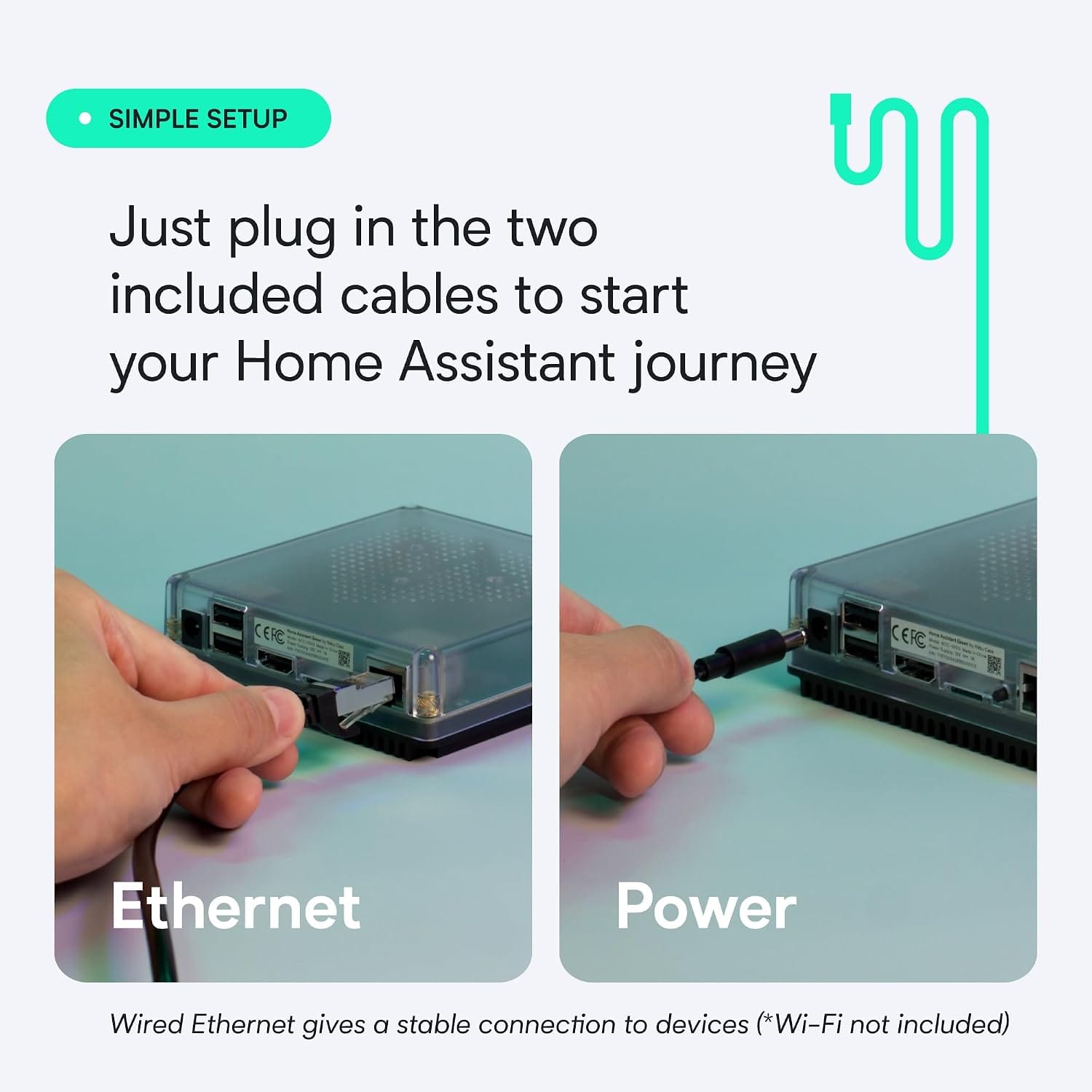
Thinking about buying Home Assistant Green as your first Home Assistant server? You’re not alone. It’s heavily advertised as the official plug-and-play way to get started. But before you spend $219 for it on Amazon, you here is that I think is a much better Home Assistant Green alternative that costs less than a dinner out and will save you from a major upgrade headache later.
For beginners, the Green sounds perfect: no flashing, no tinkering. The problem is what you don’t see on the ad. It’s locked to weak, non-upgradable hardware that many users quickly outgrow. I would have outgrown Green after my first two weeks of adding devices, apps, etc.

What Is Home Assistant Green and Why Is It So Popular?
The Home Assistant Green is the official hardware from Nabu Casa — the force behind Home Assistant. It’s a small box with a Rockchip RK3566 quad-core processor, 4GB of LPDDR4 RAM, and 32GB of eMMC storage. It comes with Home Assistant OS pre-installed. But I contend that’s not the whole story…

For a total beginner who has never flashed an SD card, that simplicity has real value. You plug it in, it works. But that simplicity comes at a long-term cost: you are locked into that hardware forever.
The Big Problem: Soldered, Non-Upgradable Hardware
Here is the detail that most reviews skip. Both the 4GB RAM and the 32GB eMMC storage on the Home Assistant Green are soldered directly to the motherboard. That means they are not realistically upgradable. What you buy is what you are stuck with.
For a device that is supposed to be the brain of your entire smart home for years, that is a critical flaw. I can’t stress that enough. Over time you’ll find it’s simply not enough.
32GB Storage Is Not Enough for a Real Smart Home
When you start, 32GB feels like plenty. After a few weeks, it isn’t. Home Assistant is constantly writing data:
- History and Recorder database: Every sensor state, temperature reading, and motion event is logged.
- Backups: A full backup with a few add-ons can be 2-4GB each. You want to keep 3-5 of them.
- Add-ons: Want to run Frigate for cameras, Plex, AdGuard, or a local voice assistant? Those need gigabytes of space.
- Logs: Home Assistant OS updates, Supervisor, and add-on logs grow quickly.
Once that 32GB fills up, Home Assistant becomes slow, unstable, and can even stop recording history. Your only real fix is migrating to entirely new hardware.
4GB RAM Limits Your Future
4GB is okay for 20 devices and 2 add-ons. It is not enough for what most people become. When you add camera processing, Matter/Thread, ESPHome compiling, and AI voice assistants like Whisper and Piper, RAM usage spikes. With soldered RAM, you cannot add more. You have to buy a new box. I know! My camera recordings alone eat storage and I only keep two week’s worth — then they overwrite.
Home Assistant Green Price vs. Performance Reality
As of this week, Home Assistant Green is $219 on Amazon for 4GB RAM / 32GB storage, no expandable storage slot, and no RAM upgrade path.
Now compare that to what you can find on eBay, Facebook Marketplace, or local thrift stores:
A used 2011-2012 Apple Mac Mini with 8-16GB RAM and a 256GB+ SSD costs $50 to $75. That is 1/3 the price for 3-4x the hardware.
| Feature | Home Assistant Green ($219) | Used Mac Mini ($50-$75) |
|---|---|---|
| RAM | 4GB Soldered, Not Upgradable | 8-16GB, User Upgradable to 16GB |
| Storage | 32GB eMMC Soldered | 256GB-512GB SSD, Easily Replaceable |
| Processor | RK3566 4-core ARM | Intel i5/i7 Quad-core (Much faster for compiling/add-ons) |
| Upgradability | None | Full – RAM, SSD, even second drive |
| Ports | 1x Gigabit, 2x USB 2.0 | 4x USB 3.0, Gigabit, HDMI, Thunderbolt |
The Smarter Home Assistant Green Alternative: Used Mac Mini
This is my recommended Home Assistant Green alternative for anyone comfortable with 30 minutes of setup. The 2011-2012 Mac Mini (model A1347) is a tank.
Why it is better for Home Assistant:
- Real upgrade path: You can open the bottom cover and swap RAM in 2 minutes. You can swap the 2.5″ SSD with any cheap SATA SSD.
- Way more powerful: An Intel i5-3210M benchmarks 2-3x higher than the RK3566. Compiling ESPHome firmware goes from 5 minutes to 45 seconds.
- Bare metal or virtualized: You can install Home Assistant OS directly, or install Proxmox / Debian and run Home Assistant in a VM alongside Plex, Pi-hole, and more. You can’t do that on Green.
- Reliability: These Mac Minis have enterprise-grade aluminum cooling and were designed to run 24/7 in server closets.
- I run my Mini with with two monitors connected, one HDMI and one DP/Thunderbolt. Each screen is parked on particular home automation screens that I monitor constantly.
Power consumption? A 2012 Mac Mini idles at 11-13W with an SSD, about $15-$20 per year in electricity. Very close to the Green.
For more about Home Assistant from the horse’s mouth, click here.