
When The Zombie Apocalypse Happens…

I get it. When things really go south, there’s no time to study for an amateur radio license. This post isn’t about big-brother government, free speech, or being a “sovereign citizen.”
This is about the hard truth of ham radio for preppers. If you think you can buy a radio, throw it in a Faraday cage, and figure it out when the world ends, you are setting yourself up to fail.
Why Ham Radio for Preppers Is NOTHING Like CB or GMRS
Ham radios are NOTHING like CB, FRS, or GMRS radios. They are far more complex in bare metal and operational capabilities. A CB is channelized and plug-and-play. A ham radio is a wide-open, highly technical instrument.
They can operate on a wide variety of bands enabling communications over short and long distances, practically 24×7, IF AND ONLY IF you know what you are doing. Being prepared isn’t just about buying the gear and securely storing it away for a quick bug-out. You have to know propagation, antennas, power, and operating procedure before you need it.
I Am Friends With a Prepper Family. Here’s How I Tried To Help Them
When I first got to know them, they were smart, motivated people. They had done what most people do – research using Reddit and YouTube. They had invested real money. They purchased:
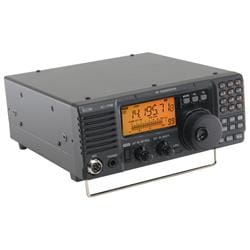
- Icom IC-718 HF transceiver — still in its factory-sealed carton
- End-fed 10-80 meter half wave antenna — still in its original packaging
- Several Baofeng UV-5R class handheld transceivers with rubber duck antennas and desktop chargers — two had been unpacked, all battery packs were dead
- All of the above were neatly and securely packed in a reinforced weatherproof container. Ready for transport at a moment’s notice

On paper, it looked great. In reality, this is the most common failure I see with ham radio for preppers.
But Here’s What They Forgot (Didn’t Know They Needed)
After I looked at their kit, I made a list. This is what was missing:
- That Icom has no built-in antenna tuner. It will need a good quality, wide bandwidth tuner to be able to match to their end-fed antenna. Without it, the radio will fold back power or not transmit at all, and you could damage the final transistors.
- That Icom has NO built-in power supply. It needs an external AC to DC 12v switching power supply rated at least 30A for full rig power output of 100 watts. Or a large battery bank and a way to charge it. The radio is useless without clean, stable 12V power.
- No coaxial cable to connect the rig to the antenna. Not a single foot of RG-8X or LMR-240, no PL-259 connectors, no adapters.
- No way to recharge the handhelds while traveling. No 12V car charger, no USB battery eliminators, no AA battery pack, and no spare batteries. Those Baofengs are dead weight after 8 hours.
- No tools, no knowledge, no practice. No SWR meter, no frequency list, no understanding of what band to be on. NOT GOOD.
Why Gear Without Knowledge Equals a Big Fail
Not to belabor the point, but even if they had all the necessary HF accessories, they would still be lost using the Icom. Here is a hypothetical but very realistic operating situation:
It’s 8 pm in November. You need to contact a friend who you think is 50 miles away on the other side of a mountain. Cell phones are down.
- Which frequency band should you try on the Icom? Hint: This is not line-of-sight like those Baofengs.
- Since it’s nighttime, bands above 20m will probably not be appropriate. 10, 12, 15, 17 meters are likely dead.
- So maybe 30m or lower, but you can’t transmit voice on 30m. It’s CW and data only.
- 40 or 80 meters may work for a 50-mile NVIS path, but which voice mode, LSB or USB? On 40 and 80 you use LSB, on 20 and above you use USB. If you get it wrong, no one will understand you.
- And what frequency? How do you tune to that frequency and make sure you’re getting out? That end-fed antenna is going to need tuning on every band change, but you don’t know for sure. No experience.
- Your cell phone doesn’t work or you don’t think it’s secure. But you just need to communicate… no time for all the junk. What now?
To an outsider, the above situation and all of its problems just point to a BIG FAIL. Way too complicated.
To an experienced ham radio operator, it would be a piece of cake. We know what to have; how to set it up; and how to use it. We know 40 meters at night with NVIS will get over that mountain. We know where the emergency nets are. We also know how to contact a family member on the other side of the country.
How to Actually Do Ham Radio for Preppers Right
Ham radio is NOT rocket science — the learning curve can be easy. BUT there is a learning curve and FCC licensing as well. The license isn’t just a legal formality; it forces you to learn fundamentals that will save your life later.
If you are serious about emergency communications, do this in order:
1. Get licensed first. Start with Technician, then General. You will learn bands, modes, and basic electronics. Without a license,If you do figure out how to transmit on a ham radio, you’ll be ostracized on the air — you’ll stick out like a sore thumb.
2. Buy, then USE your gear. Unbox that Icom. Put up that end-fed. Make 50 contacts before you pack it away. Learn what bands are open at what time. That’s critical. By the way, that can change drastically by next year or the year after. Just pulling the plug and waiting five years to try the gear again will put you into a hopeless spiral going nowhere. You won’t remember anything.
3. Build a complete station. Radio + tuner + power supply + coax + antenna + battery + charger + spare parts. Test it on battery power for a full weekend.
4. Join the community. Check into local nets. Do a Parks on the Air activation. Join your local ARES or RACES or ham radio club.
Want to learn more about ham radio? Go to arrl.org and/or try this beginner ham radio book.
P.S. I did offer advice to the prepper family about what else they needed to buy and why, and offered future help to get them up and running, but I never heard back from them. Radio silence! <g>
P.P.S. A lot of the prepper advice on YouTube about communications is absolute hogwash. These self-styled preppers and fake hams are clueless. They’re on YouTube to monetize their channels at all costs. Period. Beware.