

I Finally Tried the Baofeng UV5-R Mini – And I Got It For $15
I have waited and waited to try out the Baofeng UV5-R Mini. This week’s Amazon Prime Day deal finally caught my attention: only $15. I pulled the trigger. Side note: next day the price increased by 25% LOL. For that price, I figured it was a no-risk experiment to add to my shack.
After a few days of daily use, including mobile and fixed operation here in a very rural area, I can say this: this tiny radio is shockingly good for the money. This is my full hands-on Baofeng UV5-R Mini review.
PSA: Ignore the Amazon Listing – This Is NOT an Adult Walkie-Talkie
About the radio’s description on Amazon. BEWARE. As usual, it’s strewn with errors and misstatements. Typical Baofeng. As a ham, I’ve long since learned to take Baofeng descriptions in general with a grain of salt. I generally know what to expect feature-wise and I’m okay with that.
This is important: This is an amateur ham radio – NOT an adult walkie-talkie, NOT an FRS prepper radio. An FCC amateur radio license is required to transmit. It will not work out of the box with FRS, GMRS, or MURS frequencies. It only transmit on two amateur radio bands. If you are unlicensed and want a radio that just works out of the box with family, you need FRS class radios. Click here for my recommended FRS radios that don’t require a license.
Unboxing: What You Get And What You Don’t
After a quick unboxing, I noticed something immediately. There was no included user guide. Over the years I have criticized Baofeng about how poor its documentation is – but this takes it to new heights. None!
In the box you get the radio body, a 1,600mAh Li-Ion battery, the stock rubber duck antenna, a belt clip, a lanyard, and a USB-C charging cradle. Build quality feels solid for a $15 radio. At first blush, how small this radio is – is amazing. So tiny! And I mean that in a good way. It’s so much easier to carry, use, and store while on-the-go in comparison to my usual daily driver, a Baofeng AR-5RM.
How I Programmed the UV5-R Mini in 5 Minutes With CHIRP
I always use CHIRP. Always reliable.
- I charged the radio to 100%. Took a couple of hours to get there.
- Plugged in my Baofeng CHIRP programming cable and connected it to my desktop PC.
- Set CHIRP to UV5-R Mini and downloaded from the radio to create a fresh image.
- Opened my existing master image file which contains the frequencies and associated settings for the repeaters in my area.
- Copied over that file to the new radio image.
- Uploaded the revised image to the radio.
Done! Couldn’t be easier. Took me all of five minutes and my new Baofeng is ready to go. If you are new to CHIRP, always download from the radio first – never upload a blank file from another model.
Battery Life and Charging: My 20-80 Rule
The UV5-R Mini uses a Li-Ion battery pack, not the old NiMH style. Li-Io batteries are happiest when kept between 20% and 80% charge contrary to the many conspiracy theories and old wives’ tales out there on social media. I charged to 100% for the first calibration, but over time I’ll do my best to keep the charge between 20% and 80% to extend battery life.
The radio defaults to Battery Saver mode. I actually like it a lot – it’s as if I’m in automatic scanning mode, but the display is blank until a signal is heard. It dramatically extends standby time.
Size Matters: UV5-R Mini vs. Baofeng AR-5RM
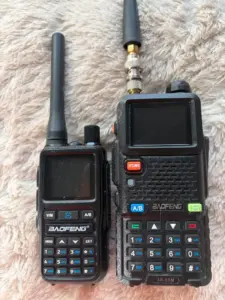
The physical size of the radio is the main story here. Next to my AR-5RM, the Mini looks like a toy. In the car I can simply store it in the center console – no need to remove the antenna. It just fits with room to spare! Or I can clip it to the sun visor – it’s so lightweight you forget it’s there.
I’ll leave the stock rubber duck antenna on for the time being. I live in a very rural area. The closest repeaters are 20 miles away, but the ones I typically use are 65 miles away. I may need to switch to my Nagoya 771 whip – time will tell. For now the stock antenna is doing fine for local simplex and the closer machines.
Display and Everyday Usability
The display screen is smaller in comparison to my AR-5RM, but it’s still perfectly functional. Menu navigation is standard Baofeng, so if you know one Baofeng, you know them all. In direct sunlight, readability will be a problem, but that’s typical of any Baofeng or my Yaesu FT-60R for that matter. The keys have a positive click and the volume knob is smooth.
My Custom Settings in CHIRP
Performance-wise it is solid out of the box, but I did go back into CHIRP to modify some of the radio’s default settings to match my preferences:
- Changed Power On Display Type to BATT voltage – Much more useful than a welcome message. I can see battery health at a glance.
- Increased the three timers to longer values – TOT, backlight timer, and auto power off. Personal choice for longer operating sessions.
- Turned on dual watch – Essential for monitoring my primary repeater and the national calling or other frequencies at the same time.
Real-World Performance: Rural Range Test at 20 Miles
This is where I was most surprised. In on-the-air comparisons to my AR-5RM and Yaesu FT60R, both fixed and mobile, there are NO differences. Full stop. I can reach the same repeaters, full quieting, from my base location 20 miles out.
For a radio this small, that is impressive. It shows that receiver sensitivity and the transmitter PA are very similar to the full-size UV-5R series. Your antenna matters more than the radio body at this point.
On-Air Audio Comparison: UV5-R Mini vs Yaesu FT-60R
On some of the repeaters I frequent, if my transmit audio quality was anything less than perfect, those boys would let me know immediately – have had zero complaints. Reports were that audio was loud and clear with no distortion. Compared directly to my Yaesu FT-60R, which costs 15 times as much, the difference on receive and transmit audio is negligible on FM. The Yaesu wins on build, speaker quality, and front-end filtering in a high-RF environment, but for everyday repeater use, the Mini holds its own.
Who Should Buy It And Who Should Skip It
Buy it if: You are a licensed ham looking for an ultra-compact backup, a glovebox radio, or a lightweight carry for hikes and events. For $15, it’s a disposable price with keeper performance.
The only con I’ve found is the belt clip. I don’t expect it to last that long.
Skip it if: You are unlicensed and looking for family walkie-talkies. You need waterproofing, or you operate in a heavy RF intermod area where you need a superhet receiver like the Yaesu. Also skip if you need 220MHz or airband – this is a standard dual-band VHF/UHF only.
Final Verdict: Is the $15 Baofeng UV5-R Mini Worth It?
For $15, this ham radio is amazing. Highly recommended. It programs easily with CHIRP, it’s unbelievably small and light, and it performs identically to my larger Baofengs on distant repeaters. The missing manual is annoying but every setting is covered in CHIRP anyway.
If you see it again under $20 on Amazon, grab one. Keep it in your go-bag, your car, or your desk drawer. At this price, you can afford to have a spare ham radio that actually works.
I help many prospective hams get licensed over the years. My blog post here will get you started in the right direction.
GL & 73 de K7UU