
Why Cheap UPS Brands Will Cost You More in the Long Run
Everyone loves a bargain until the power goes out. I have watched a $45 bargain UPS take a $2,000 gaming rig down with it. If you are searching for the best reliable UPS brands, you need to know why cheap UPS brands are a false economy.
After 20+ years running servers, home labs, and client workstations, I have a very short list of UPS brands I trust when data actually matters. Skrimp $$$ and you’ll be sorry. I can say that from personal experience. Unfortunately.
The Only Reliable UPS Brands I Trust
If you look at what IT pros actually deploy, the same four names come up over and over. The most popular reliable brands are APC, CyberPower, Eaton, and Tripp Lite. In enterprise, you also see Vertiv Liebert and Delta, but for home and small business, it is really APC and Eaton.
1. APC — My Choice
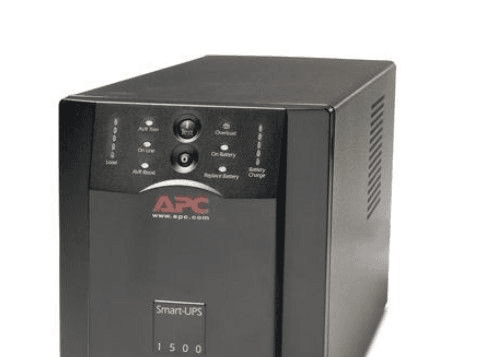
Choose APC when you want one brand from desktop to server room with the easiest parts and battery sourcing. The Back-UPS Pro and Smart-UPS lines are boringly reliable. Battery replacement takes two minutes with a front-panel door, no tools. Their PowerChute software actually works for graceful shutdown.
2. Eaton – The Enterprise Tank
Choose Eaton when voltage regulation and build quality are the priority. Eaton focuses on premium segments with excellent build quality. Their 5S, 5P, and 9PX lines, plus the Tripp Lite SMART series they now own, are tanks. The Eaton 5S 1500VA gives you LCD status, EcoControl to save energy, and a 3-year warranty that includes batteries.
3. Tripp Lite by Eaton – The Workhorse
Not flashy, but the SMART1500LCD, SMART1500RM2U, and OMNI series just work. Purpose-built with pure sine wave output, automatic voltage regulation, and expandable runtime. Now that Eaton owns them, support is better than ever.
4. CyberPower – My Complicated Experience
On paper, CyberPower looks like the best value. Reddit communities frequently endorse the CyberPower CP1500PFCLCD because it offers pure sine wave output for less money than APC. It even comes with a $375,000 connected equipment guarantee.
My experience has been different. I have owned four CyberPower units in five years. One CP1500 model was very difficult to replace batteries on – you had to disassemble half the case and fight ribbon cables, versus APC’s tool-less door. Two other units failed completely after only about 12 to 14 months. This was not a dead battery issue, the inverter boards themselves failed under normal loads well within spec. I know many people love them, but when you have two units die just out of warranty, you stop recommending them for anything critical. That horrible smell of burning electronics is front and center when I think about the CyberPower brand.
7 Reasons Cheap UPS Brands Cost You More
If you are writing a blog or buying your first battery backup, understand this: cheap UPS brands cut corners where you cannot see them until it is too late.
1. Simulated Sine Wave That Kills Modern PCs
This is the number one reason to avoid cheap UPS brands. Cheap units output power that isn’t in spec or in a non standard waveform which can really damage your power supply and components. Many cheaper line-interactive models output a square wave or stepped simulated sine wave instead of a true sine wave. Every modern PC, NAS, and gaming console uses an Active PFC power supply. Those PSUs will buzz, instantly shut off on battery, or literally blow capacitors when fed a simulated wave. Pure sine wave output ensures your server receives clean, stable power that prevents hardware stress.
2. No Automatic Voltage Regulation (AVR)
A good line-interactive UPS from APC or Eaton corrects brownouts from 83V to 145V without touching the battery. A cheap standby UPS slams to battery every time voltage dips. Most budget UPS don’t offer great surge suppression, have a lifetime of 2-3 years before the battery dies, and don’t regulate voltage. That constant cycling kills batteries in a year.
3. Inflated VA and Watt Ratings
That XYZ listing on Amazon for “2000VA / 1200W” for $69 is lying. Put a real load tester on it and it folds at 500W. Reliable brands list both VA and real watts honestly and are tested to UL1778. A cheap UPS that claims 2 minutes runtime at full load often gives you zero seconds when you actually need it.
4. Joke Surge Protection
I have measured budget units with 300 joules of protection. The APC Back-UPS Pro 1500VA is 1080 joules. The CyberPower CP1500PFCLCD is 1500 joules. One nearby lightning strike and that cheap MOV is toast. Worse, it is dangerous to plug a surge protector into a UPS that outputs a stepped wave because some surge protectors may see the stepped wave as surges and try to clamp them, causing it to burn up.
5. No Graceful Shutdown Software
Premium UPS units come with PowerChute, Eaton UPS Companion, and PowerPanel that shut down your NAS, server, or PC cleanly. Budget UPS brands have no USB communications or software. Power dies, your RAID array and unsaved work die with it. That alone negates any savings.
6. Cheap Batteries and Real Safety Risks
Major brands use similar suppliers, but APC and Eaton provide better documentation for maintenance and have thermal cutoffs. Budget brands use no-name cells that swell, leak, and in worst cases are a fire risk. I have pulled swollen batteries out of no-name units that were only 10 months old.
7. No Real Warranty or Equipment Guarantee
APC gives you 3-year warranty plus $150,000 connected equipment protection. Eaton gives you 3-year including batteries. CyberPower gives $375,000 to $500,000. Cheap UPS brands give you a 30-day return to a seller that disappears in 3 months. That guarantee is your insurance policy.
What Should You Buy Instead of Cheap UPS Brands?
For my own gear and for clients now, I keep it simple and avoid cheap UPS brands entirely:
- Home office, gaming PC, NAS: APC Back-UPS Pro 1500VA BR1500G or Eaton 5S 1500VA. Both are line-interactive, pure sine wave, 10 outlets, and have an easy battery door.
- Small rack or homelab: APC Smart-UPS SMT1500 or Eaton Tripp Lite SMART1500RM2U. Network card option, real AVR, and I can get a replacement battery at any local battery store.
- What to avoid: Any unit that lists “simulated sine wave” or “modified sine wave” if you have a modern PC. Any brand with no UL listing and no downloadable shutdown software.
A cheap UPS costs $70 every year plus risk. A reliable UPS costs $240 to $350 once for 5-6 years plus one $50 battery swap. Cheap UPS brands are not cheap. They are just cheaply made.
Final Verdict on Cheap UPS Brands
If you are protecting a $100 router, a budget standby UPS is okay. If you are protecting a PC, NAS, or anything with data you care about, buy APC or Eaton. My mixed experience with CyberPower pushed me firmly back to APC Smart-UPS and Eaton 5S for client work. Spend the extra $150 now, or spend $1,000 later replacing hardware and recovering data.